
What Is Panorama Photography and Why Do Landscapes Look So Stunning?
What Is Panorama Photography and Why Do Landscapes Look So Stunning?
Stand at the edge of a mountain valley in the North Cascades or along the Oregon coast at golden hour, and you'll notice immediately that no single camera frame does the view justice. The eye sweeps left to right across a hundred and twenty degrees of light and detail, taking in ridgelines, water, sky, and foreground all at once. That gap between what the eye perceives and what a standard photograph captures is exactly what panorama photography was built to close.
At its core, panorama photography is a format designed to record an unusually wide field of view, producing an elongated image that stretches the scene horizontally in a way a single frame simply cannot. The result is not just wider, it is compositionally different, experientially different, and when printed at scale on a material like Chromaluxe metal or HD acrylic, it commands an entire wall in a way standard rectangular prints rarely achieve. Many gallery visitors report stopping mid-step in front of a wide-format landscape print when the scale and detail demand that kind of attention.
Understanding what panorama photography is, how the format developed over more than a century, and why landscapes come alive inside it opens up both a richer way of seeing and a richer way of displaying what you find.
What Is Panorama Photography, Definition and Aspect Ratios
A panorama photo is defined primarily by its aspect ratio. The minimum threshold is generally 2:1, meaning the image is at least twice as wide as it is tall, a standard recognized across photography textbooks and industry guides. In practice, many panoramas reach 3:1, 4:1, or beyond, stretching the frame into a long horizontal strip that matches or exceeds the natural sweep of human vision. That visual scope, roughly 120 degrees or more horizontally, is the experiential target the format is always chasing.
The important distinction is that panoramic photography describes an outcome and an intent, not a specific lens or camera setting. A wide-angle lens sees more of a scene in a single frame, but the result is still a standard rectangular image. Shooting with a 14mm lens is not automatically panoramic photography. A fisheye lens covers an extreme field of view but introduces curvilinear distortion across an image that is not elongated and is not considered a panoramic format. Wide-angle and fisheye describe how the image is captured or projected; panoramic describes the wide, strip-like composition and the breadth of view that defines it.
The format can be achieved several ways: through a dedicated panoramic camera that exposes a wide strip of film in a single pass, through multiple overlapping digital frames assembled into a stitched panorama, or through an in-camera panorama mode on a phone or mirrorless body. What matters is the final image's proportions and the intent behind them. Full 360-degree panoramas, which wrap the viewer completely in all directions, extend the concept further into immersive spherical capture, but the core principle remains the same: more scene, more context, more of what was actually there.
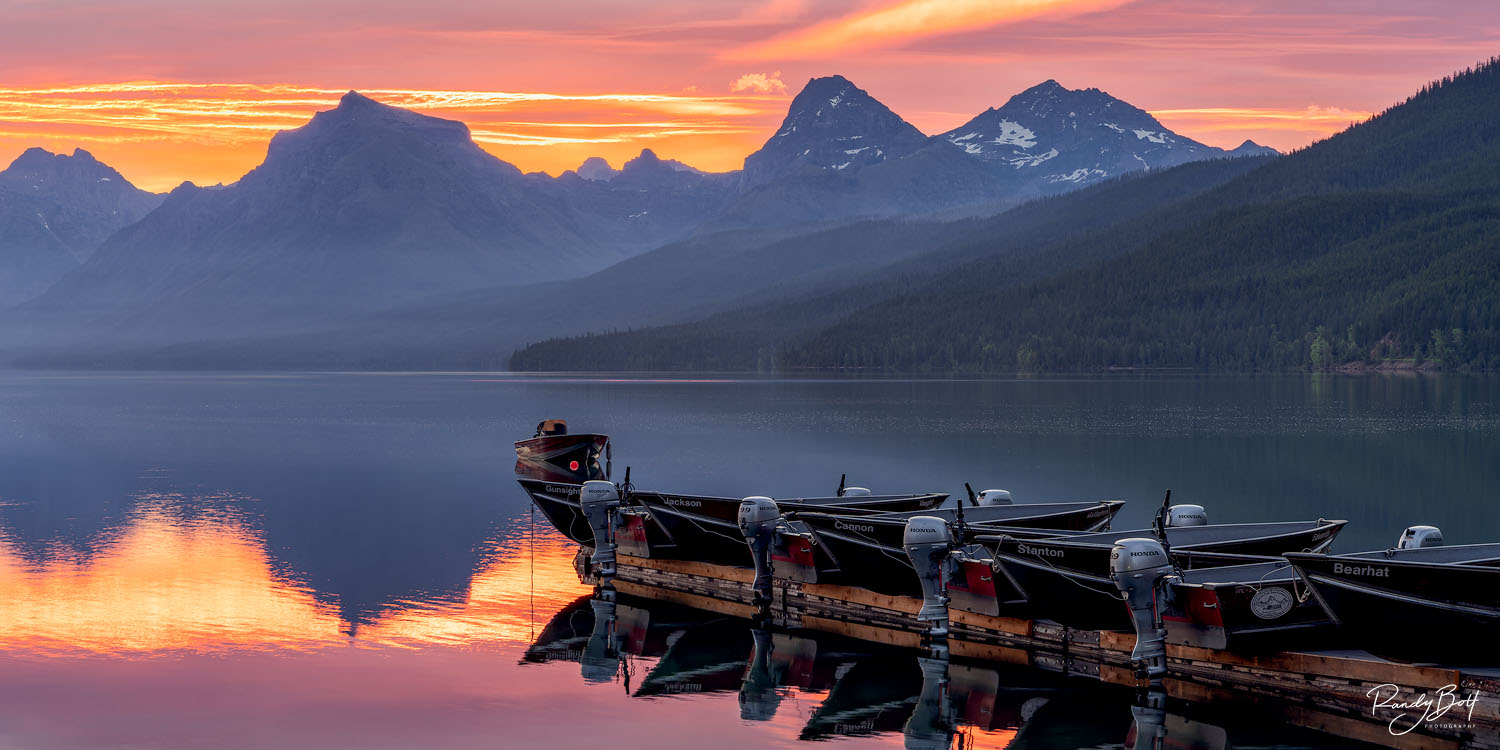
The wooden dock extends into the glassy, perfectly still water that pulls the viewer’s eye straight into the heart of Glacier National Park. On the dock are the iconic, brightly colored small rental motorboats and canoes. At this hour, they sit entirely motionless, casting crisp, mirrored reflections across the dark surface of the lake. Through the ultra-clear shallows near the shore, the lake's famous rainbow-colored, glacier-carved pebbles are subtly visible beneath the water's surface. Limited edition print from the Panorama gallery.
A Short History of the Wide Frame
Panoramic photography predates digital by more than a century. Within years of photography's public introduction in 1839, photographers were already stitching daguerreotype plates side by side to capture cityscapes too wide for a single frame. By the mid-1840s, purpose-built panoramic cameras had arrived. Friedrich von Martens developed one of the earliest successful models around 1844 and produced surviving panoramic daguerreotypes of Paris, now held in major photographic archives, that remain among the most recognized photographs of the 19th century.
By the 20th century, dedicated film panoramic cameras had become serious tools for landscape photographers. Cameras like the Fuji GX617 and the Linhof Technorama 617 exposed a wide strip of 120 medium-format film across a 6×17 cm frame in a single pass, producing aspect ratios associated with a particular grandeur that standard photography could not replicate. The Widelux, the Horizon 202, and the Hasselblad XPan each offered their own approach to the wide frame, attracting photographers who understood that certain subjects simply required more horizontal space to be seen honestly.
The shift to digital changed the economics and accessibility of the format without changing its appeal. Instead of a specialized camera, any photographer with a DSLR or mirrorless body could shoot overlapping frames and merge them into a seamless panorama using panorama stitching software. This unlocked panoramic aspect ratios at far higher resolutions than most film cameras could produce, giving photographers the detail needed for large, fine art-quality prints. Modern smartphones now include panorama modes as standard features, which has introduced the wide-format aesthetic to a generation of photographers who have never loaded a roll of 120 film.
How Panorama Photography Makes Landscapes Come Alive
Many landscape subjects, a mountain range, a sweeping coastline, an old-growth forest, don't fit comfortably inside a 3:2 frame. The standard crop cuts off exactly what makes those subjects feel immense and uncontained: the peripheral reach, the continuation of the scene beyond what the eye rests on, the sense that the landscape extends past any single viewpoint. Panoramic photography restores that sense of peripheral breadth, so the viewer feels like they are standing inside the scene rather than looking at a photograph of it.
The elongated frame also changes how the viewer moves through the image. A standard photograph is taken in at a glance. A panorama forces the eye to travel, to sweep from one edge to the other the same way it does across a real landscape. That movement takes time, and time is what gives wide-format landscape images their sense of depth and atmosphere. The format itself becomes part of the experience.
Black and white and infrared landscape photography tend to suit this format particularly well as an aesthetic choice. The extended tonal range across a wide frame gives the eye more variation to settle on at any point: a dark ridgeline at the left edge, a bright sky opening at center, shadow detail deepening toward the right. A panorama displayed at 48 or 60 inches wide reads as an environment, not just a photograph. The wider the scene, the more completely the format earns its size, and the more powerfully it rewards a viewer willing to stand in front of it and look.

At sunrise, Moraine Lake in panorama format reveals an unforgettable scene of color and scale. The calm turquoise water stretches wide across the frame, perfectly mirroring the towering peaks of the Valley of the Ten Peaks. Soft golden light touches the rugged summits, casting a gentle glow that contrasts with the cool blues of the lake below. Along the shoreline, clusters of evergreens add depth and balance to the vast landscape. The panoramic view captures the full sweep of mountain, sky, and water, creating an immersive sense of being surrounded by the majesty of the Canadian Rockies at the break of day. Limited edition from the Mountains gallery.
The Gear and Settings That Make Clean Panoramas Possible
Any camera that shoots in manual mode and supports RAW files can produce quality panoramic source images. A mirrorless or DSLR system gives you the most control over exposure, focus, and file quality. Modern phone cameras with exposure-lock modes work for entry-level panoramas, though they produce narrower dynamic range and less flexibility in post-processing. For large-format fine art output, RAW files from a dedicated camera remain the stronger foundation.
Wide-angle lenses in the 24mm range or shorter are widely recommended for panorama work because they cover more of a scene per frame, which means fewer frames are needed to complete a wide sweep. Fewer frames mean less cumulative stitching error and a cleaner final merge. A sturdy panorama tripod is not optional for serious wide-format work: a level, stable rotation base keeps the horizon consistent and the panorama stitching clean across the entire sequence. Shooting handheld introduces camera tilt variation between frames that stitching software can only partially compensate for.
For scenes with foreground interest close to the camera, a panoramic head matters significantly. It allows the camera to rotate around the entrance pupil of the lens, the no-parallax point. That rotation eliminates the parallax shift that causes near and far objects to misalign between frames. For distant landscapes with no close foreground, a standard ball head on a leveled tripod is usually sufficient. On the settings side, the three non-negotiable rules are manual exposure locked across every frame, manual focus set before the sequence begins, and a fixed white balance. Any variation between frames creates visible seams that stitching software cannot fully correct.
The Shooting and Stitching Workflow at a Glance
Start at one end of the scene and work consistently across in a single direction. Shooting in portrait (vertical) orientation gives the stitched panorama more height to work with after cropping, which matters when the final image reaches 4:1 or wider. Overlap each frame by 30 to 50 percent: more overlap gives stitching software more matching detail to work with, which reduces alignment failures, especially in skies with minimal texture. Move deliberately between frames, stopping fully before releasing the shutter each time.
In Lightroom Classic, select your frames in sequence and use Photo Merge to open the panorama dialog. According to Adobe's Lightroom Classic documentation, the preview lets you compare projection types: spherical handles most wide landscapes well, while cylindrical works cleanly for simpler horizontal sweeps where you want vertical lines to stay true. Enable Boundary Warp conservatively to fill irregular edges, and use Auto Crop to remove jagged borders. Apply lens corrections to your source images before merging to reduce alignment stress at the frame edges.
The three most common problems in stitched panoramas are parallax errors, exposure seams, and alignment failures. Parallax is fixed with a proper pano head or by keeping foreground objects well away from the frame edges. Exposure seams are fixed by shooting in strict manual mode. Alignment failures are fixed by increasing frame overlap and keeping the camera level throughout the sequence. Most stitching problems trace back to the field, not the software. When the source images are captured correctly, the merge is usually straightforward.

The sea stacks of the Boardman Corridor stand in stark, dramatic contrast to the turbulent ocean waves crashing at their base. The jagged formations rise from the water like ancient sentinels, their rough textures and towering presence amplified by the monochrome tones. The surrounding sea churns with frothy white caps, creating a dynamic tension between the solid, unyielding rocks and the ever-moving water. The sky, with its soft gradients and rolling clouds, adds to the scene’s grandeur, evoking a sense of raw, natural power. The absence of color enhances the rugged beauty of the sea stacks, highlighting their striking shapes and creating a timeless, almost otherworldly atmosphere. Limited edition from the Panorama and Black and White galleries.
From Wide-Format Capture to Fine Art Wall Piece
A panoramic landscape image holds its emotional weight only when the output matches the intent. Printing a 4:1 aspect ratio image on standard paper at a small size reduces it to a decorative strip with none of the impact that justified the format in the first place. The format earns its power at scale: 40, 48, or 60 inches wide, at a resolution that holds detail under close inspection, on a surface that contributes to the image's depth and presence rather than flattening it.
At those dimensions, the print material becomes part of the image. Surface quality, color depth, and long-term archival stability all determine whether a wide-format landscape print creates a lasting sense of place or simply occupies wall space. Randy Bott Photography produces limited edition panoramic landscape prints on chromaluxe metal and HD acrylic, two materials particularly well suited to wide-format display. Chromaluxe prints the image directly onto aluminum, producing vivid color and dimensional depth with archival permanence rated by the manufacturer for decades of display life. HD acrylic mounts the image behind a thick acrylic face, giving it a luminous, gallery-quality depth that rewards close inspection and shifts subtly with the light in the room.
Each limited edition print is produced in a controlled edition, signed and numbered by the artist, and accompanied by a Certificate of Authenticity. For collectors, that provenance matters: it ties a wide-format landscape print to a specific artist, a specific capture, and a documented place in a finite edition. A panoramic landscape image, printed at this level of production quality, stops being photography in the decorative sense and becomes an environment, something you walk toward rather than past.
The Format Rewards What Landscapes Deserve
Panoramic photography is one of the few formats where the technical method and the emotional result align completely. The wide frame exists because wide scenes deserve it, and when the format is applied with patience and intention, it captures something no standard rectangle can replicate. That is ultimately what panorama photography is: a commitment to matching the scale of your tools to the scale of what you're trying to preserve.
Whether you are shooting your first stitched panorama on a hiking trail or studying the lineage of film-based panoramic cameras that stretches back to the 1840s, the format rewards deliberate seeing above almost any other approach. The technique is learnable and the gear more accessible than most beginners expect. What it asks for most is the willingness to slow down and let the scene unfold across the full breadth of your frame before you fire the first shot.
For photographers and collectors who want their best wide-format captures to live on a wall at a scale that does justice to the original scene, the path from careful capture to limited edition fine art print is shorter than most people expect. What panorama photography offers, at every level of experience, is the rare chance to see more, record more, and share more of what the landscape actually looked like when you were standing inside it.

The golden light washing across the rolling fields of green and yellow as a lone farmstead sits quiet. At sunrise, the rolling hills of the Palouse glow in the golden hour light, their gentle curves bathed in soft hues of amber, green, and gold. The first rays of the sun stretch across the landscape, casting long shadows that accentuate the undulating terrain, creating a breathtaking contrast between light and shadow. The fields, covered in wheat and barley, ripple in the morning breeze, their dewy surfaces shimmering as they catch the sun’s warmth. Limited edition print found in the Palouse and Panorama galleries.

